Rohan’s solo rescue mission
The InvincibleRohan’s solo rescue mission is the decisive search for the missing members of Regnar’s expedition, undertaken when the Invincible can no longer protect or retrieve them by ordinary means. Its significance lies in the collision between rescue duty and the recognition that Regis III’s black mechanical cloud cannot be treated as a conventional enemy: Rohan must enter its domain almost unarmed, accept the likelihood of death, and discover whether human survival remains possible in a landscape shaped by millions of years of inanimate evolution.
Causes and Background
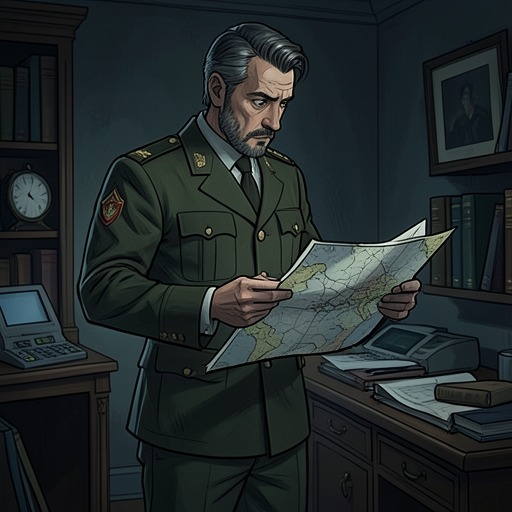
Horpach has not yet decided whether the Invincible should leave Regis III or remain. He refuses to settle the question by chance and gives Rohan the power to decide, but the discussion soon exposes a deeper obligation. The commander argues that the expedition cannot simply depart while the fate of the missing men remains uncertain. At the same time, normal rescue methods have become impossible. The cloud can destroy vehicles, disrupt communications, disperse when attacked, regenerate its losses, and move to other regions of the planet. It is not merely a force that can be defeated by striking a single target.
The proposed mission therefore makes Rohan a deliberate exception to the ship’s defensive system. Horpach explains that only one person may be able to enter the ravine and return without a helmet, vehicles, or weapons. Two unmanned jeeps are to draw the cloud away and be destroyed, while a third carries Rohan toward the northern edge of the plateau. He is then to descend on foot into the upper ravine, where caves, potholes, and galleries might conceal survivors. The plan depends on speed, concealment, and the hope that the men reached terrain inaccessible to the cloud rather than on any prospect of overpowering the adversary.
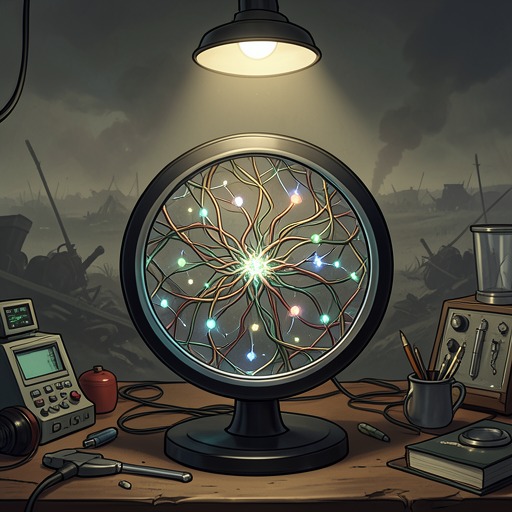
The mission is also framed by the expedition’s changing understanding of Regis III. Evidence from the strata shows that land life disappeared over millions of years as metallic layers began to form, although the planet’s limited radiation could not account for the extinction. Fossils prove that the land once supported plants and primitive reptiles, while later sediments contain metallic substances and traces resembling corroded microscopic mechanisms. The biologist’s conclusion is stark: life still exists in the ocean, but land life was wiped out more than five million years ago. The cloud is thus understood not as a temporary storm or an intelligent army in the human sense, but as an inanimate evolutionary system perfectly adapted to destroy living and intelligent forms.
Preparation and Entry
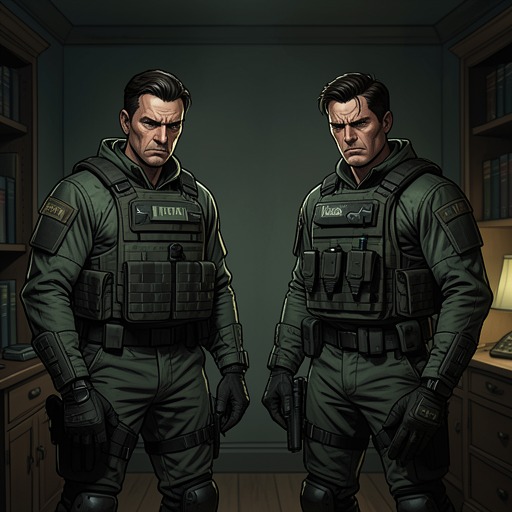
At dawn, the first two jeeps descend the Invincible’s ramp and pass through the opening force field. Rohan crouches on the rear step of the third jeep in a jumpsuit, wearing neither helmet nor protective goggles and breathing through a small oxygen mask. The equipment reveals how completely the mission has been designed around the cloud’s relation to metal. His clothing contains almost no metal parts; he carries ampoules, nutritional tablets, a Geiger counter, a magnetic sensor, a compass, a tiny terrain photogram, and thin plastic rope. A fine wire network is hidden in his hair, and a microtransmitter sewn into his collar sends a controllable pulse, while a tiny receiver allows the Invincible to communicate with him without giving away his position.
This equipment turns the rescue into a study in subtraction. The expedition’s usual advantages—vehicles, weapons, protective systems, and continuous radio contact—would expose or endanger him. Rohan must instead rely on a limited oxygen supply, a small number of tools, a map no larger than a postage stamp, and his ability to move unnoticed. Horpach’s plan allows eighteen hours of oxygen, and the route is chosen to avoid the paths of the previous expeditions: Rohan is to drive close to the plateau’s northern edge and descend into the upper section of the ravine on foot.
The journey through the ravine is physically precarious from the beginning. Rohan descends across steep rock and black, bristling vegetation, watching the small clouds suspended in the air. He is nearly at the ravine floor when loose scree slides beneath him. He falls, loses his oxygen mask, and rolls down the slope, but the immediate danger is not the injury to his leg; it is the cloud that forms above him as he lies exposed among the rocks.
Encounter with the Cloud
The cloud surrounds Rohan as a shapeless black mass accompanied by a hum that moves from a high hiss into deep bass tones. He remains motionless while a twisting limb descends toward him, its tip resembling a glistening black whirlwind. The cloud’s contact is intimate but strangely diffuse: the air touches his face like a breath broken into innumerable particles, and something brushes the breast of his suit. Then the limb withdraws, the buzzing intensifies inside his skull, and the cloud rises, spreads across the valley, divides into separate spinning clumps, and disappears into the undergrowth.
Rohan remains still for a long time, afraid that the cloud may have erased his identity or memory. When he realizes that he can still think, he understands that he has survived and that the cloud has not harmed him. His relief erupts as suppressed, almost hysterical laughter. The encounter changes the mission’s value structure: the supposedly defenseless man has passed through the cloud’s reach, but survival provides no security. The person he had seen from the ridge has vanished, and the sound of footsteps draws him onward through the ravine.
The scene also gives physical form to the expedition’s uncertainty about the cloud. It does not behave like a reasoning opponent making a calculated decision, yet it is not harmless. Its capacity to disperse, approach, withdraw, and transform its surroundings makes ordinary distinctions between organism, machine, weather, and weapon inadequate. Rohan survives not by defeating it, but by remaining unnoticed or by exploiting a difference between what is lethal to biological life and what the cloud recognizes as a threat.
Search and Discoveries
Rohan searches the ravine’s caves and underground passages while racing against exhaustion and the limits of his supplies. Some galleries are filled with water and lead to vertical wells and roaring subterranean streams; others have high ceilings and multiple levels that his weak flashlight cannot adequately illuminate. He finds what may be the remains of a macrorobot destroyed during the ancient battle between the Cyclops and the cloud, including loosened fastenings and rods that appear intended for flight rather than walking. The discovery places the present rescue within the planet’s much older mechanical history: the ravine is not only the scene of a recent disaster but also a geological archive of the struggle through which Regis III’s inanimate systems developed.
After resting on a sun-warmed rock and eating an energy tablet with water from the stream, Rohan notices that he is becoming less disturbed by the dangers around him, even though black bushes cover every slope within sight. This reduced fear does not mean that the landscape has become safe. It reflects the narrowing of his task to concrete actions—searching, following traces, measuring radiation, and deciding whether to turn back. The mission’s psychological pressure is expressed through dwindling energy, unreliable sounds, and the constant possibility that a cloud is approaching.
A thin rusty streak across the dry boulders finally gives the search a direction. Rohan identifies it as dried blood and follows the trail up the valley. The traces cross and disappear, but eventually lead him to a narrow vertical shaft near the entrance of a cave he had already searched. There he finds Bennigsen’s head staring upward with empty eye sockets and bared teeth. The gold-rimmed spectacles identify the geologist, whose body is wedged vertically between the rocks. Decomposition has already softened the body under the jumpsuit, accelerated by the sun.
Rohan cannot recover the remains, but he opens the breast pocket, takes Bennigsen’s identification tag, and moves a nearby slab of rock to cover the grave. The gesture is small and practical, yet it prevents the mission from reducing the dead to mere evidence. Bennigsen’s identity is restored through the tag, and his exposed body is given a minimal burial in the same ravine where the search has brought Rohan.
Certainty, Loss, and Continuation
Near the end of the day, Rohan reaches territory altered by the previous battle. His Geiger counter begins to register rising contamination; rocks show the cracked glaze of thermal impact, and some boulders are covered with frozen bubbles where their surfaces boiled. The gateway has collapsed into a hollow basin, the rock has become lava-like crust, and the black metallic undergrowth has been burned into scraps. The landscape itself records the scale of the weapons used against the cloud, including the antimatter strike that transformed the air, debris, steam, gases, and smoke around the Cyclops into extremely hard radiation.
A flash of metal then reveals another victim. In a crevice between the cliff and the dried stream bed lies a body in a scorched jumpsuit. It is headless, crushed against the boulders by some terrible blast, and impossible to identify. Nearby, however, Rohan finds an undamaged holster containing a battered Weyr gun and takes the weapon. The discovery confirms another death without supplying the personal certainty he came to obtain. Bennigsen can be named and buried; the second man remains an anonymous casualty of the battle.
At this point Rohan faces the mission’s central dilemma. He has survived, found human remains, and established that at least one missing man is dead. By his reckoning, the death of the fourth man is almost certain, and the original rescue objective may already be impossible. Yet he possesses oxygen for six more hours, and returning would leave the question unresolved. He is also exhausted, with the night ahead and no clear way to continue. The decision to press on is therefore not a triumphant advance but a choice made after hope has been replaced by the demand for certainty.
The expedition’s final meaning extends beyond the recovery of missing men. Rohan’s experience coincides with his recognition that humanity has no right to impose its own measure of intelligence and survival on Regis III. The planet’s mechanical forms may lack conscious intention, but they have established an effective equilibrium over millions of years. The rescue mission exposes the cost of entering that equilibrium with weapons and assuming that every hostile effect requires revenge. Rohan’s search remains an act of responsibility toward the missing, but it also becomes an encounter with the limits of human mastery: he can identify the dead, carry a weapon from the ruins, and continue into danger, yet he cannot turn the planet’s autonomous history into a human war with a clean victory.